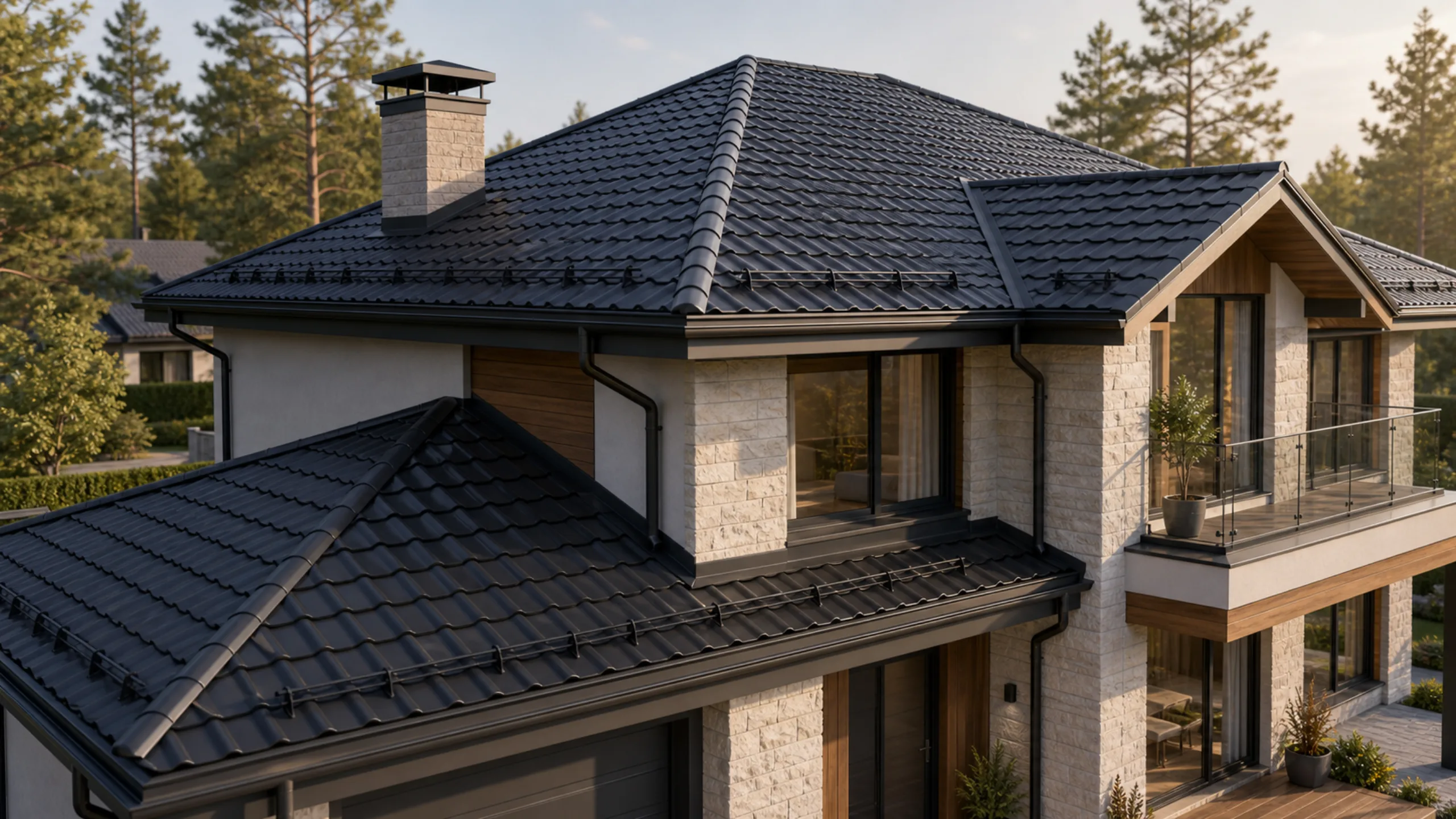
Metal roof tiles are one of the most popular roofing materials.
It is made from thin polymer-coated steel sheets by profiling (cold forming).
Metal roof tiles are now one of the most widely used roofing materials.
They were invented in Finland in the early 1980s. The rest of Europe then began testing this durable roofing material.
Metal roof tiles were successfully tested in harsh Scandinavian conditions. This meant the covering was suitable for Russia's wide variety of climate zones.
Metal roof tiles appeared on the Russian construction market in the early 90s and quickly became a leading roofing choice.
It did not immediately become a material for everyone. Initially, their use in construction signalled considerable financial means.
They were typically used on luxurious country houses.
New manufacturers gradually entered the Russian market, joint ventures opened and the first domestic factories began production. A wide choice became available across different price ranges.
The domestic construction industry now produces competitive products. The equipment and manufacturing methods are the same as those used in Scandinavia.
Major companies closely monitor metal product quality throughout production. Only advanced equipment and computerised production processes are used. This eliminates the possibility of defects.
What are metal roof tiles made from?
Metal roof tiles are made from galvanised steel sheet 0,3–0,5 mm thick with a polymer coating.
This layer provides both protection and decoration:
- gives roofing sheets a rich colour, in either a gloss or matt finish.
- hot-dip galvanising gives steel corrosion resistance and helps it withstand external mechanical effects.
The sheet also contains auxiliary primer and passivation layers.
They lie between the zinc and polymer and help prevent or slow chemical reactions associated with metal oxidation.
This roofing material is versatile. It is used on various pitched roofs with a minimum permitted pitch of 14 degrees; otherwise, sheets need a two-wave overlap.
Metal roof tiles suit private and public buildings, both single-storey and multi-storey. This material is also often used for roof repairs and restoration.
What coatings are available for metal roof tiles?
Coating types:
- Polyester coating is available in gloss or matt.
What are the benefits of a matt finish? Its textured coating improves resistance to mechanical damage and allows repainting during its service life. - Plastisol coating. A choice for regions with humid climates.
- Pural coating. Advantages: high resistance to all weather conditions and treatment with an anti-corrosion compound. Drawback: a limited range of colour shades.
- Polyvinyl fluoride coating. Known for its elasticity and flexibility in use. The colour palette is extensive.
Advantages of the material
- Low weight.
- Their low weight means no special equipment is needed to load the roofing material. There is no need to strengthen the roof frame, significantly reducing installation costs.
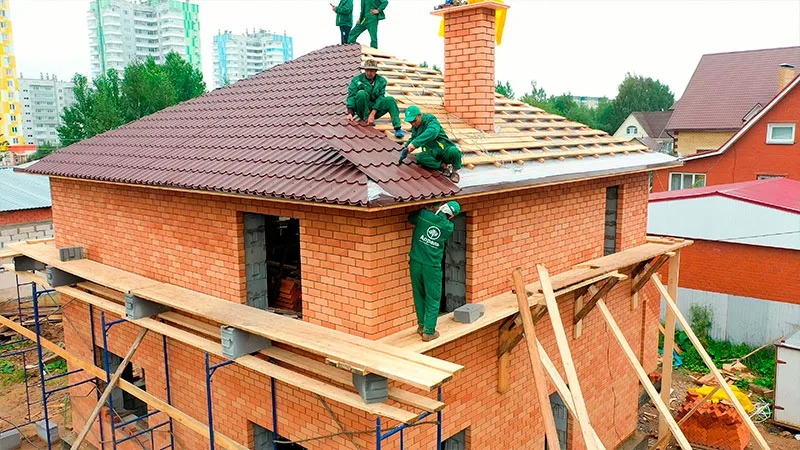
- Fast, straightforward roof installation. An experienced crew can install around one hundred square metres of roofing in a working day.
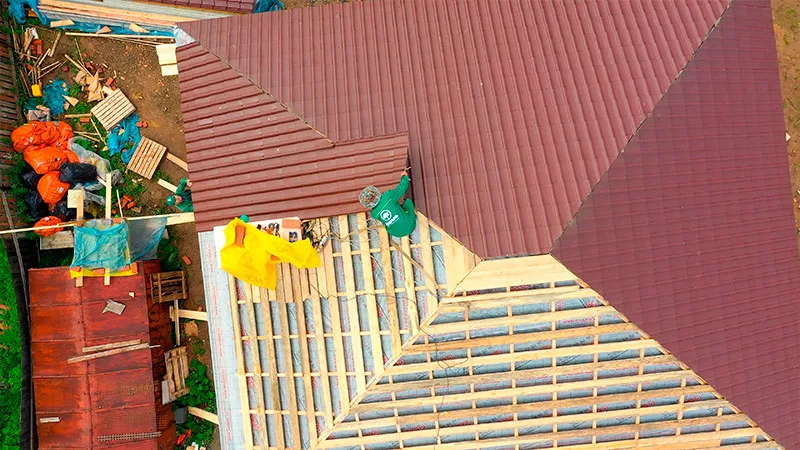
- Easy assembly. Individual sheets are fixed to the battens with special roofing screws. The material also comes with a full range of accessories.
- Long service life. A roof installed according to all applicable requirements can last over thirty years without special maintenance.
- Affordability. Metal roof tiles are relatively inexpensive. Roof installation also combines intricate detailing with simplicity, helping reduce installation costs.
- An attractive finish.
- A wide colour palette and extensive profile choice allow varied architectural compositions and imaginative designs.
- Frost resistance.
- Fire resistance.
- The smooth surface lets rainwater run off easily and prevents snow accumulation.
- Environmental friendliness and safety.
 Unfortunately, nothing in this world is perfect. The same applies to roofing materials.
Despite their considerable advantages, metal roof tiles have some drawbacks that become apparent to varying degrees in different circumstances.
- For example, snow does not remain on the roof, which is both an advantage and a drawback. The advantage is the absence of snow loads; the drawback is the danger to anyone caught beneath sliding snow. This drawback is addressed by fitting safety elements: snow guards.
- Increased roof noise is often cited as a drawback, but a covering installed correctly will not cause inconvenience.
What should you consider when choosing metal roof tiles?
Modern metal roof tiles are a worthy alternative to many roofing materials.
When choosing this covering, consider:
- material thickness: very thin material needs prompt installation and more careful handling;
- zinc coating: the optimum amount is around 275 g/m²;
- the primer layer, which should exceed 15 microns. It improves adhesion and protects the zinc from deterioration;
- the type and thickness of the polymer layer, which are particularly important for a quality roof covering;
- surface finish: matt, gloss, embossed, metallic and others; it does not affect strength or resistance to external conditions;
- the level of environmental pollution.
When buying metal roof tiles, consider both material quality and correct roof installation.
Only a competent approach to this process will produce a strong, reliable roof.
When choosing this material, we recommend specialists who can carry out the full scope of work, from the rafter structure to drainage, snow retention and soffit installation.
And remember: with a trusted building crew, you will have a reliable roof over your head.
How to choose a roofing material
Roofing affects the home's appearance, loads on the rafter structure, noise, installation, maintenance and the lifespan of the whole roof.
Roofing material decisions are best considered alongside the design, site, budget and future use of the home.
Common mistakes
A common mistake is choosing a covering solely for its price or colour. Consider pitch, roof shape, snow loads, detail complexity and installation quality.
Another risk is relying solely on other people's experience without considering your own site, design and family's needs. General construction advice often needs to be adapted to specific conditions.
Roofing considerations
- roof pitch and shape;
- roof covering weight and loads on the rafters;
- noise, ventilation and drainage;
- installation and component quality.
When to choose roofing
It is best to select the covering alongside the roof design. The rafter structure, details, roof-space ventilation and drainage can then be calculated correctly.
Even if a decision has already been made, review it before work starts on site: clarify the limitations, related work, material requirements and impact on the home's future use.