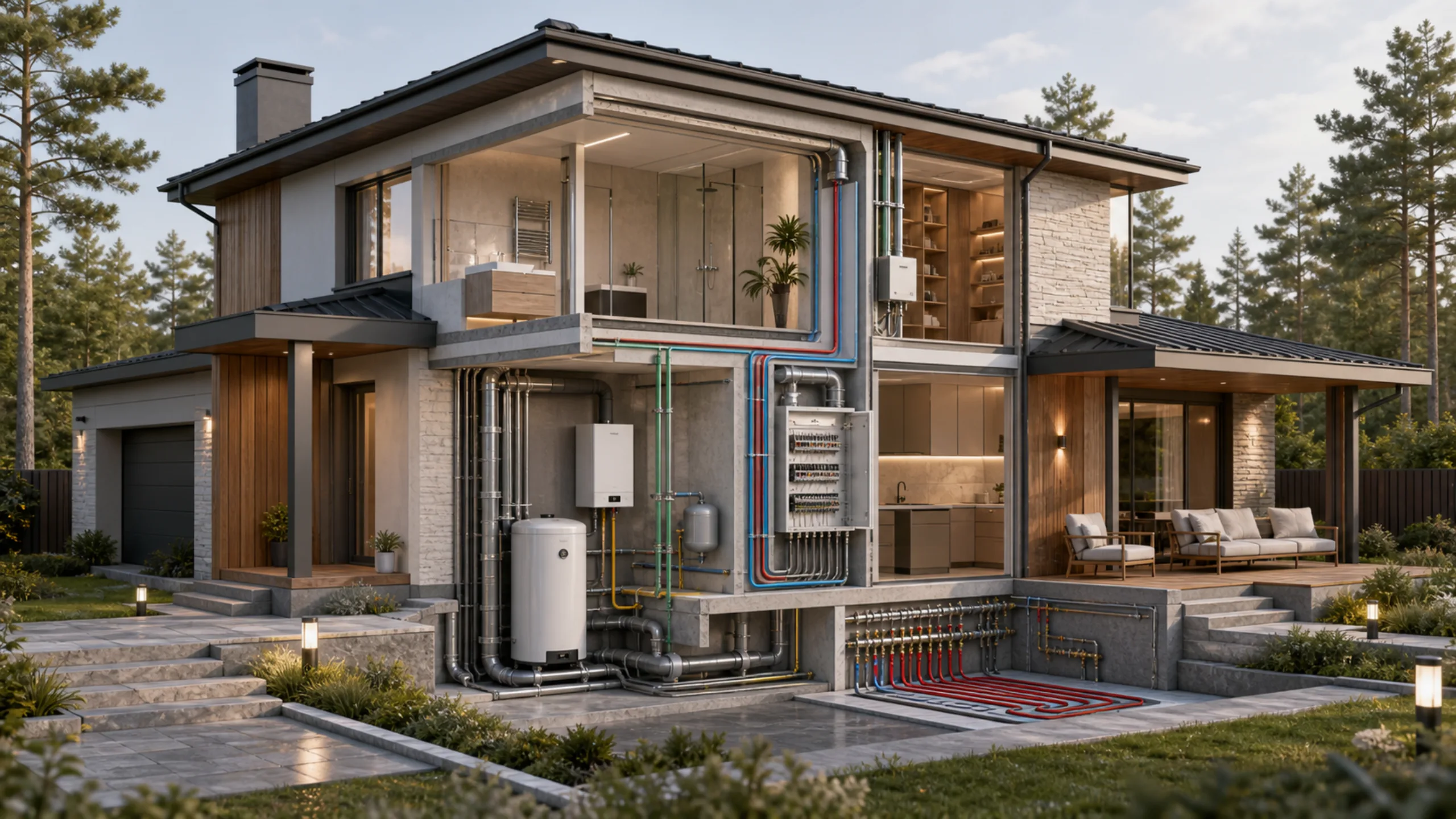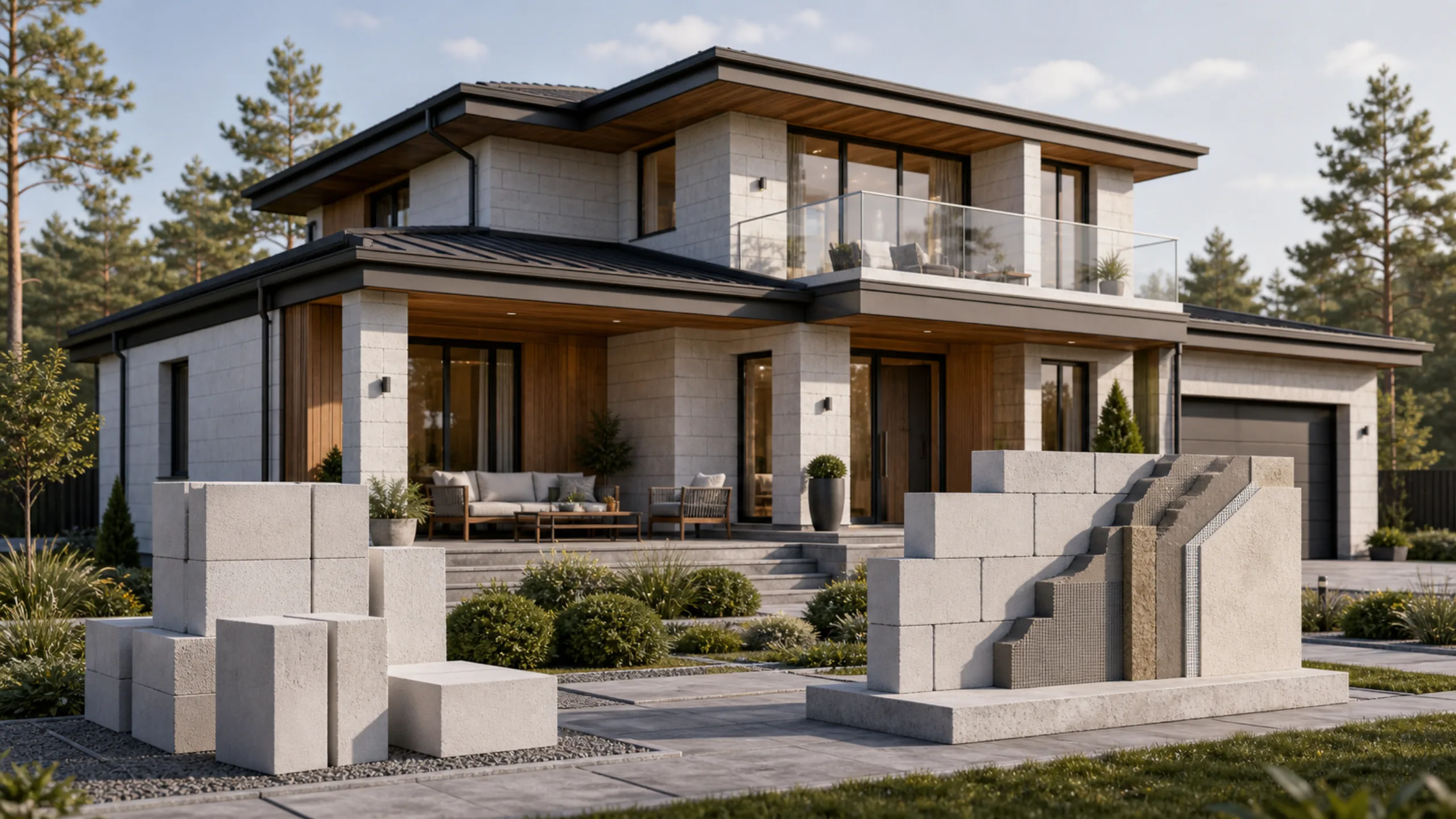
Aerated concrete, also known as aerated concrete blocks or artificial stone, is a versatile modern material in the cellular concrete family. It is used for load-bearing and external walls in structures of any complexity. Widely used for low-rise homes, garages, workshops, offices and other buildings.
What are aerated concrete blocks made from?
Cellular concrete mainly consists of cement, water, quartz sand and specialist gas-forming agents. Lime, gypsum and other industrial materials may also be added.
Using aerated concrete blocks for houses still raises some debate and doubt. A definitive answer to 'Should I use aerated concrete to build a house?' is difficult, so we suggest examining this manufactured material's advantages and disadvantages in detail.
Advantages of an aerated concrete house
Aerated concrete offers the following advantages.
- Affordability. Aerated concrete is one of the least expensive modern materials, so a house costs much less to build than one made of glulam or brick.
- Environmental performance. Manufactured stone contains no environmentally harmful impurities and therefore emits no harmful substances. In environmental terms, aerated concrete is comparable to clay and ceramic brick.
- Frost resistance. Correctly built aerated concrete homes retain their strength despite substantial temperature changes over many years. This is particularly important in regions with a sharply continental climate. We use only high-quality aerated concrete, so your home will withstand at least 50 of even the harshest winters.
- Fire resistance. Aerated concrete blocks do not burn and therefore do not produce smoke. Manufactured stone walls can withstand direct flame exposure for more than three hours. This property is particularly valuable in fire-prone regions.
- Low weight. The porous material makes aerated concrete homes lighter, significantly reducing foundation loads.
- Earthquake resistance. Aerated concrete buildings perform very well in areas of increased seismic activity. This is explained by the material's low weight and strength. Construction in earthquake-prone regions requires particular attention to calculations.
- Versatility. Manufactured stone is used for both homes and agricultural buildings. Aerated concrete blocks can also be used to add storeys to older buildings. With accurate calculations, the material will not place a significant load on the foundation.
- Sound insulation. With correctly sized blocks, no additional sound insulation is required. Aerated concrete walls more than 20 cm thick absorb sound and external vibrations very well.
- Easy processing. The material's low weight allows blocks to be handled without special equipment. It can be cut and shaped with an ordinary handsaw. Even non-professional builders can build a house from aerated concrete blocks.
- Thermal insulation. An aerated concrete house retains heat much better than brick. This property provides substantial heating-season savings and reduces air-conditioning use on hot days.
- A wide choice of aerated concrete. You can choose manufactured stone in different strengths, sizes and shapes.
- High vapour permeability. The porous material maintains an ideal indoor climate. An aerated concrete home always has excellent air circulation.
- Construction speed. Their low weight allows aerated concrete blocks to be quite large. One block is generally the size of several bricks, so walls can be built several times faster than with other materials. Building the walls of a single-storey aerated concrete house takes 1 to 3 months on average.
- Insulation. Aerated concrete houses can be insulated externally with basalt or stone wool without concern about block deterioration even after 20–30 years. Provided the insulation is installed correctly, of course. Our company favours material uniformity, so we build with 400 mm aerated concrete walls, which is sufficient without additional insulation.
- Structural complexity. Manufactured stone allows unconventional architectural solutions, including curved structures and arches.
- Reliability and durability. With correct construction methods, aerated concrete homes last more than 70 years. The walls do not develop mould, so unpleasant odours do not arise.
Aerated concrete blocks are ideal for house construction, especially on a limited budget. It is used for internal partitions, load-bearing walls and floors, and also suits insulation of low-rise buildings.
Aerated concrete also has some disadvantages.

Disadvantages of an aerated concrete house
- Use in low-rise buildings. Because of its porosity, aerated concrete should not be used as the main material for buildings taller than three storeys.
- Installing fixings. The porous structure makes fitting furniture more difficult. Special fixings are needed to secure cabinets or hang shelves.
- Deformation. If the foundation is designed or built incorrectly, microcracks may appear in aerated concrete walls after several years. These are usually not dangerous but are seen as a visual defect.
- Low bending strength. Porosity is one of the main characteristics of aerated silicate blocks. Choose reinforced aerated concrete blocks when building walls. The material withstands heavy loads but is brittle in bending.
Aerated concrete has far fewer disadvantages than advantages. All can be resolved with the right approach and correct construction methods.
Aerated concrete houses: owner reviews
Aerated concrete blocks have been used in construction for several decades. You can find many reviews and opinions from homeowners online.
Here are the main points raised by people already living in aerated concrete homes.
- Sergey, 38, homeowner 'We spent a long time deciding what to build our house from. We chose aerated concrete. For us, it was the best option in terms of price and construction time. The house was built in 3,5 months. We finished just before the rains. Six months later, by the start of the heating season, we had moved into our own home. We encountered a finishing problem. The blocks turned out to be so smooth that plaster would not adhere. We simply needed specialist materials. We have now lived here for 4 years. Everything is great. People said the walls would crack, but nothing of the sort happened. A significant benefit is the saving on heating. The house is very warm and comfortable. That matters in our freezing winters. Overall, I recommend it to everyone.'
- Ivan, 42, homeowner 'The construction company we worked with recommended aerated concrete. I hesitated for a long time but listened to the professionals. They built me a wonderful house in 3 months, just as my wife and I wanted. What we liked:
- Speed. The house grew before our eyes.
- Savings throughout. Aerated concrete blocks are affordable. Their size means less adhesive is needed. We also did not add sound or thermal insulation. I can say straight away that the house is very warm!
- No harmful emissions. That is a major advantage for us because my wife has allergies.
The difficulties I encountered were finishing and wall fixings. First, the finishing materials cost a little more than ordinary ones; second, I struggled to find fixings for the kitchen units in our small village.
We have lived in the house for around 5 years now. We really like it! With proper heating, it is warm in winter and cool in summer. I now plan to build sheds and a garage, also with aerated concrete blocks.'
- Ilya, 50, professional builder 'I have worked as a builder for more than 20 years. We have increasingly built with aerated concrete over the last few years. Understandably so: it is affordable and reliable. The main thing is to calculate everything correctly; the rest is straightforward. A house can be built very quickly, in just 2–3 months. Overall, I really enjoy working with aerated concrete blocks. We have built homes, summer houses, garages and outbuildings with this material. It produces neither odour nor damp. It allows any ideas and designs to be realised. I would just advise choosing the manufacturer carefully. The building's lifespan depends on following the correct construction methods.'
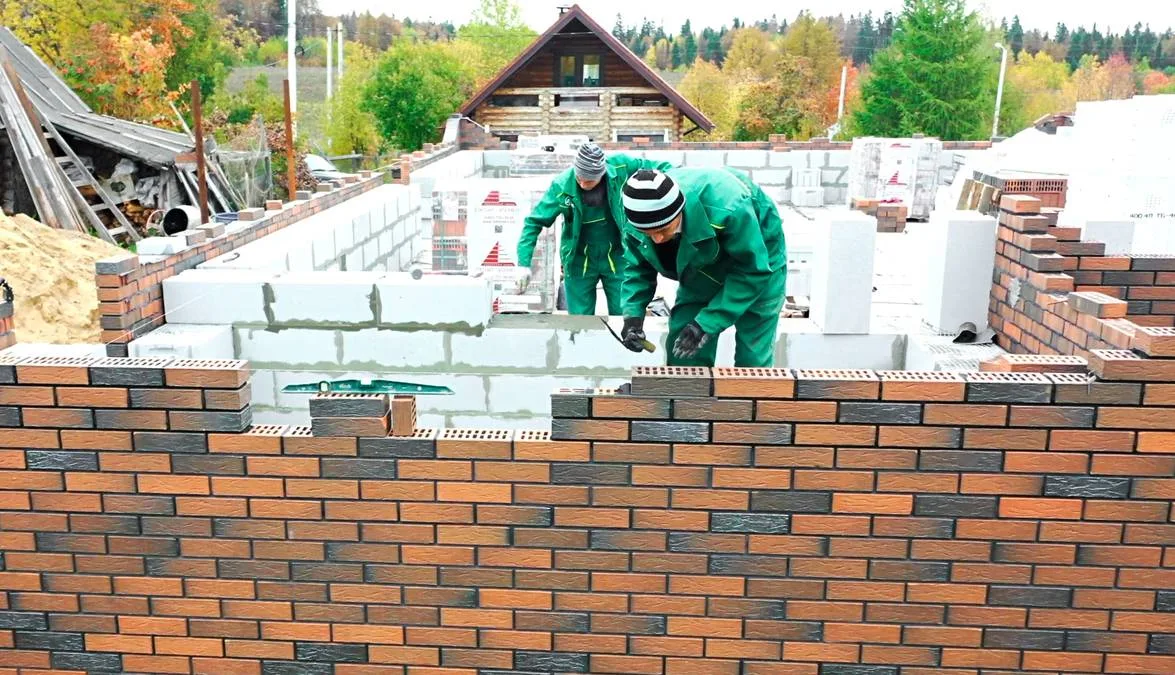
What should you know when building with aerated concrete blocks?
Aerated concrete is a reliable, durable and modern building material. The following points should be considered when working with it.
- Choose only quality materials from trusted manufacturers.
- Pay particular attention to the calculations. Consider not only climate and temperature swings but also regional earthquake and fire risks and soil quality.
- Aerated concrete should not be used to build stoves or fireplaces. The material does not burn, but prolonged fire exposure adversely affects its strength.
- The material should be well wrapped in shrink film during transport. This helps avoid excess moisture.
- Trust the professionals! For a home that is your castle and causes no problems in use, entrust construction to reliable companies!
Results
Aerated concrete houses have been popular for several years. Up to 70% of people choose them for construction. The market offers a wide range of block shapes, sizes and strengths.
Cellular concrete is lightweight and durable. It can be shaped with simple tools such as a handsaw. With correct construction methods, building takes no more than 3–4 months.
The main advantages are affordability, low weight, thermal and sound insulation, and frost resistance.
The main disadvantages are low bending strength and more complicated fixing installation. These issues can be resolved with specialist finishes and fixing systems. The future home must also be designed correctly from the outset.