P. Kramolov
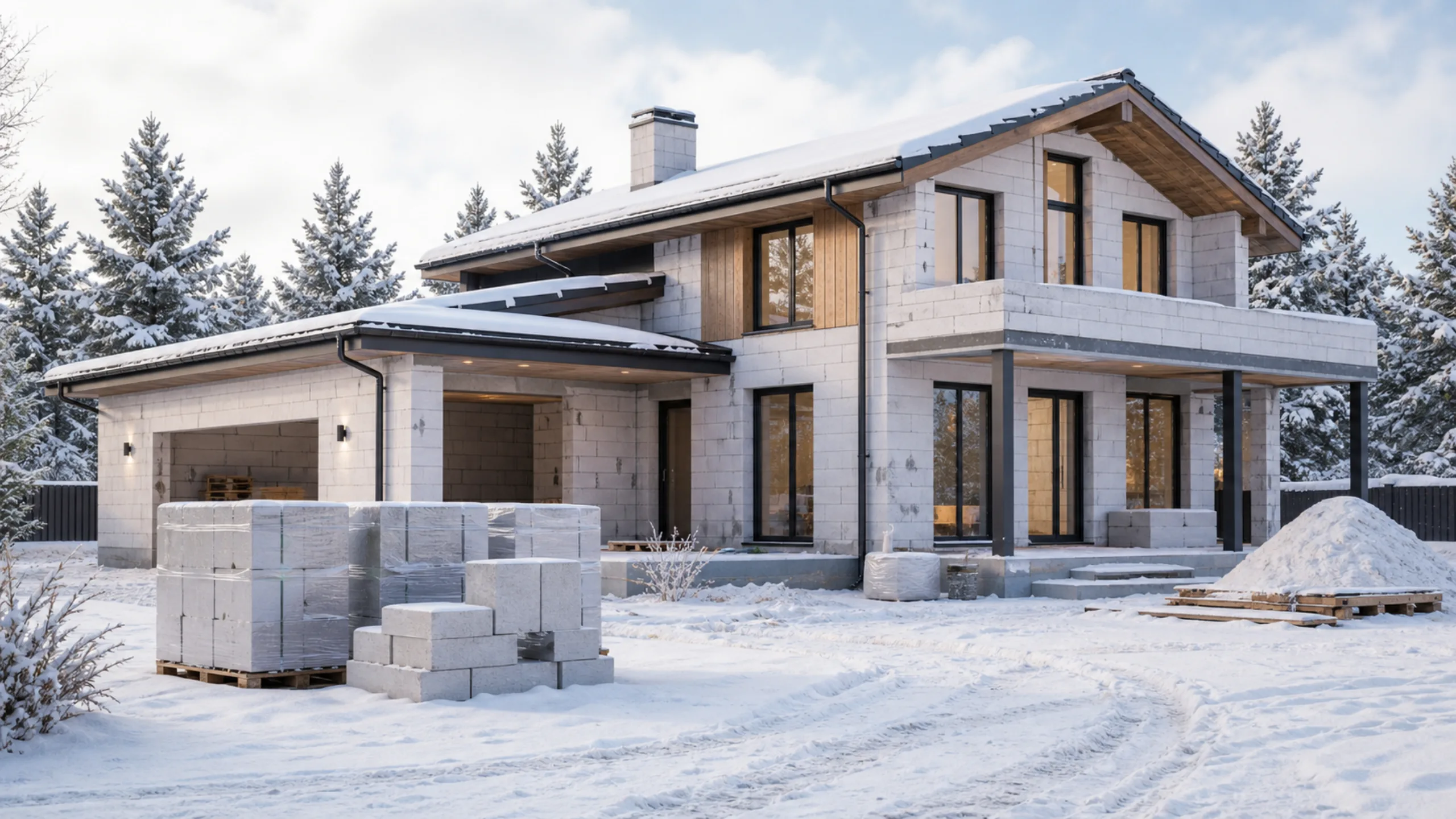
My foam concrete house is 6 years old. I specifically looked for a house made from this material, with central load-bearing brick walls, brick facing and foam concrete inside. Indoor humidity stays below 40% throughout the year. The house has gas heating, with radiators and underfloor heating. From personal experience, heating uses half the gas consumed by my previous brick house. It is warm in winter and cool in summer, with no air conditioner needed, while brick makes the structure more reliable when using concrete floor slabs. Facing brick reliably protects the foam concrete from rain and snow. The sound insulation is pleasing too, not much worse than in our brick house. Every house has advantages and disadvantages, but many drawbacks can be reduced by choosing the right plot and builders. I bought mine already built; had I commissioned it from scratch, it would have been even better!
T. Bobrikova
We have lived in a foam concrete house since 1997. My husband built it himself: two storeys and 170 m² of living space. The walls are two foam concrete blocks thick with half-brick facing. The house retains heat wonderfully and always has, with gas heating. We use long wall plugs to fix heavy items such as shelves and cabinets. The only problem is very dry air, especially in winter, so we use humidifiers. We do not even need to clear snow off the car before putting it in the integral garage. That is how it is!
A. Ryabov
When I decided to build a foam concrete house 8 years ago, our city had only one block manufacturer. The strength seems good: the walls support the upper loft-floor beams and a profiled-sheet roof rising 4 metres to the ridge. The material has one drawback: hanging very heavy things is not simple, but it can be done. Everything else is excellent. You can build the walls alone, as I did. A very warm house, warmer than a 55 cm brick wall. The exterior is simply rendered, with no insulation because there is no point. We checked with a thermal camera borrowed from a site supervisor at minus 18 degrees and found no leaks. The windows let a little heat through, as expected and as everyone's do, but the exterior walls were the same temperature as the outdoor air. I could have used brick facing, but simply applied facade render. We are in the Urals, so winter frosts are substantial.
R. Chemezov
I have lived in a foam concrete house for 11 years. For the first 2 years the house had no cladding, not to allow settlement but because I could not afford it. We have even experienced minor earthquakes. Everything is fine. A good foundation is essential and is one of the main things not to economise on. Foam concrete houses have been built for at least 30 years. I have not heard of houses collapsing. Greetings from Irkutsk.
V. Nizhegorodtsev
We built a small summer house from foam concrete. Points to note:
First, do not forget the ring beam; then pay attention to quality and choose the manufacturer responsibly. The density should, of course, be at least 600. We initially wanted reinforced concrete floors but changed our minds because of the high wall loads. We chose timber floors. Another important point is not to delay internal and external treatment. You should not cut costs on the material either. Overall, I am happy with the material for a summer house. Drawbacks may appear over time, but so far I see only advantages.
L. Chudinov
Before building, have the soil tested. Only the results can establish whether to build on the plot and which foundation type to choose. I have a 2-storey foam concrete house, 5 years old, with no problems. There are no cracks or noticeable settlement, perhaps a minimal amount with no effect. The house is not insulated, yet it is hot inside, with water underfloor heating. Building with foam concrete was my best financial decision: the material is relatively inexpensive, the house is warm and energy costs are low.
What owners most often mention about foam concrete homes
Reviews most often mention affordability, quick construction and straightforward methods. Owners also emphasise that the result depends heavily on block quality, design and wall moisture protection.
Reviews are useful when you look for recurring advantages and drawbacks of a material rather than isolated opinions.
Common mistakes
Drawbacks in reviews are usually linked to mistakes rather than foam concrete itself: inaccurate blocks, inadequate facade protection, incorrect lintels or insufficient masonry supervision.
Another risk is relying solely on other people's experience without considering your own site, design and family's needs. General construction advice often needs to be adapted to specific conditions.
What to check before building a foam concrete house
- block dimensions, density and strength;
- reinforcement, lintel and floor designs;
- timing and method of facade protection;
- the crew's experience with foam concrete masonry.
How to use reviews when choosing materials
Reviews provide useful practical observations, but should be assessed against the design, site, block manufacturer and builders' qualifications.
Even if a decision has already been made, review it before work starts on site: clarify the limitations, related work, material requirements and impact on the home's future use.