I. Bezmaternykh
I live in an aerated concrete house myself. There is no damp, I stayed warm in winter and the boiler heats it quickly. Hanging things on the wall just takes some thought and competent hands. For those just starting to build with aerated concrete blocks, here are a few rules…
- Do not insulate with Penoplex or polystyrene foam! Aerated concrete does not necessarily need insulation: it is itself insulating, permeable to vapour and allows it to escape outdoors. This is what the manufacturer recommends.
- We use only ventilated facades!
- Use special anchors to fix heavy structures inside and outside the house.
- It has good sound insulation if no gaps are left during installation.
B. Ilyin
We have lived in our aerated concrete house for several years. Many claim the material is too brittle to hang things on, especially kitchen cabinets. Nowadays, that problem is entirely imagined. To hang a picture, clock or even a light shelf, you do not even need a rotary hammer, and your picture will never fall. Plastic anchors for aerated concrete have long been available for cabinets and heavy shelves; they are strong enough to hang almost anything. I personally tested pull-out resistance with specialist equipment: one anchor easily carries 500–600 kg.
Ya. Brikulskaya
Aerated concrete is an excellent material, particularly in a cold climate. If wall thickness is chosen correctly for block density and the region, savings on heating and foundations are guaranteed. With brick facing, an aerated concrete house looks very respectable! A huge number of homeowners choose this material, and I know nobody who calculated the structure in advance and later regretted the material. It currently offers the best value for money on the market.
K. Pevzner
Having lived in a timber-frame house and now built an aerated concrete home, I have never regretted the decision. Aerated concrete is not perfect, but no material meets every requirement perfectly. Every material needs its own approach and correct methods, and has its own properties and uses. If everything follows the manufacturer's specifications rather than 'how everyone does it', the house will be warm, strong and attractive. As for brittleness, chips occur during careless transport and subsequent handling. The most important things are skilled builders and constant supervision, especially if you choose an independent crew rather than a registered company.
O. Volodin
An aerated concrete home is cheaper and more practical than one made from any other wall material. I have built several aerated concrete houses; it is my job. Use correct block-laying methods, basalt mesh joint reinforcement, minimal adhesive joints, ring beams, suitable vapour-permeable plaster inside and outside, and good ventilation, and everything will work well. The indoor climate is excellent: warm in winter, cool in summer. None of my clients or acquaintances has complained.
I. Konyaev
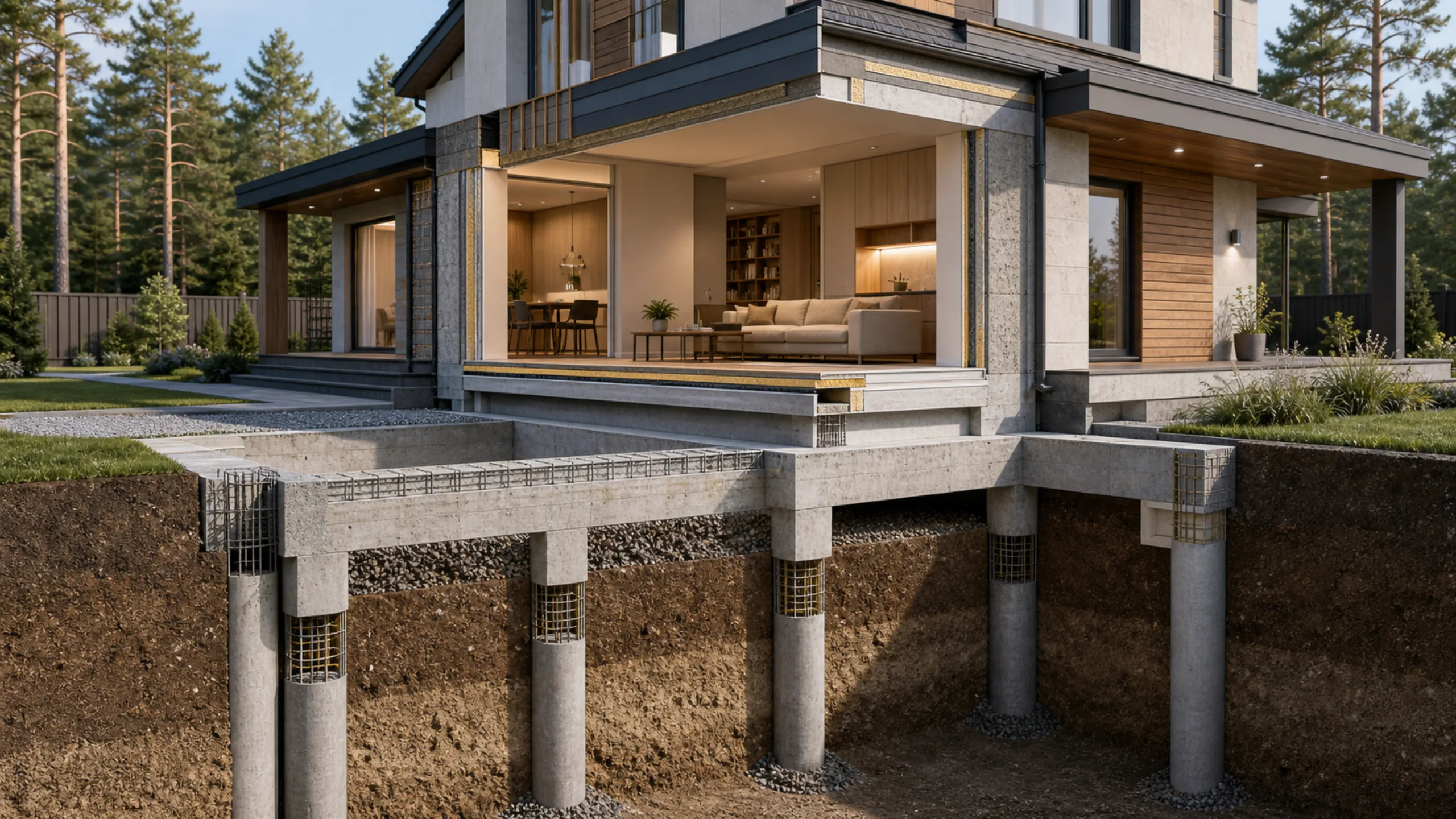
We lived for eight years in an aerated concrete house in Siberia, where winter temperatures reached minus 38. With 40 cm walls, heating our 120 m² house cost less than our neighbours' brick house. Apart from limited sound insulation, there are no other drawbacks, and there are no neighbours through the wall: it is a detached house. The claim that nothing can be fixed to it is also wrong. I hung a kitchen cabinet and a 80-litre water heater on special aerated concrete fixings without any problems. Yes, aerated concrete needs good foundations, but foundations are always a major expense when building a country house. People say aerated concrete absorbs lots of moisture, but I do not understand this: any normal home needs good ventilation. That is fundamental, and with it you will have no moisture problems.
Bazhenov R.
Our house uses D600 aerated concrete blocks, 400 mm thick, with 100 mm mineral wool insulation outside and decorative render over it. The 24 kW gas boiler is in a separate plant building. With heating on, gas consumption is around 400–450 cubic metres regardless of outdoor temperature. Heating uses water underfloor systems. The house has 7 windows of various sizes with triple glazing. The indoor temperature never falls below 25 degrees. Once, at -25 in winter, the boiler stopped. We noticed only on the second day when the hot water ran out from the indirect cylinder. The house temperature had dropped by 3 degrees over two days. The sound insulation is excellent! When a well was drilled, we could not hear the rig at all. Aerated concrete's thermal conductivity could hardly be lower! The walls are never cold in winter!
D. Kudymova
I have lived in such a house for 6 years and can say that so far, so good.
The exterior is rendered, treated with Aquastop and painted. It does not draw in moisture from outside.
We took ventilation very seriously from the design stage, because a house made from any material will be damp without it!
We have had no difficulties using the walls. Aerated concrete has its own fixings, just like other materials.
The material is not brittle: try hitting it with a hammer and it will dent slightly. Try hitting a brick! Can you see the difference?
In winter the boiler runs almost at minimum, and we wear light clothes indoors.
The conclusion is that any house will have drawbacks. You need to know how to build with each material according to building standards, SNiP and other requirements.
I work at an aerated concrete factory. They sell like hot cakes.
What aerated concrete homeowners like
Owners often mention warmth, quick construction, straight walls and comfortable living when the house follows a design and the facade is protected from moisture.
Reviews are useful when you look for recurring advantages and drawbacks of a material rather than isolated opinions.
Common mistakes
Negative reviews most often mention moisture, cracking, fixings and finishing problems. They are usually linked to incorrect construction methods, inadequate facade protection or detailing mistakes.
Another risk is relying solely on other people's experience without considering your own site, design and family's needs. General construction advice often needs to be adapted to specific conditions.
How construction quality affects the result
- block dimensions and adhesive joint thickness;
- reinforcement and lintels according to the design;
- ring beams and floor bearing details;
- timely facade protection from moisture.
Why facade protection matters
Aerated concrete is porous, so facade protection and finishes should be planned in advance. This keeps excess moisture out of the walls and preserves their designed properties for longer.
Even if a decision has already been made, review it before work starts on site: clarify the limitations, related work, material requirements and impact on the home's future use.